What Happened in African Fashion This Week.
- Hamza Olalekan Dosunmu
- Apr 11
- 5 min read

This week’s developments reflect a fashion industry operating with increased alignment across economic, cultural, and institutional frameworks.
From craft-led programmes and accelerator initiatives to policy discussions and cross-market activations, activity across the sector signals a continued focus on structure, scalability, and long-term sustainability.
At the same time, collections, retail experiences, and cultural platforms continue to shape the industry’s visual and narrative direction.
Together, these movements point to a sector progressing through both creative output and the systems supporting resilience, efficiency, and global relevance.
Clearly Invincible brings you the latest weekly African fashion recap.
Event
Homecoming 2026 Lands in Accra

Homecoming 2026 took place in Accra with a series of curated activations spanning fashion, retail, and cultural exchange, reinforcing its position as a key platform for contemporary African creativity.
A central highlight was the exclusive launch of the Homecoming TN Air Max in collaboration with Nike, hosted at Free The Youth Ghana. The event brought together members of the city’s fashion and creative community for an intimate release experience centred on product, music, and cultural connection.
The programme extended into a multi-day Homecoming Shopping Experience, designed as a curated retail and community space where attendees engaged with fashion, music, and broader creative expressions.
Founded in 2018 by Grace Ladoja, Homecoming continues to operate as a multidisciplinary platform connecting African talent with global audiences. Through its Accra activation, the initiative further explored the intersection of local identity and global culture, positioning the city as an active node within the wider Homecoming ecosystem.
Event
Woven Threads VII: CRAFTED Explores Material Systems, Circular Design, and Craft Practice

Woven Threads VII: CRAFTED has launched in Lagos as a multi-format programme examining craft as both process and system within contemporary fashion.
Curated by Sunny Dolat, the edition brings together designers, makers, and cultural practitioners working across textiles, material innovation, and circular production. The programme opened with a keynote by Omoyemi Akerele, whose address framed craft as a critical framework for rethinking material use, garment production, and long-term sustainability.
The initiative spans digital presentations, talks, workshops, and live demonstrations, positioning fashion as a system shaped by material, labour, and community. Conversations—including a moderated session led by Adaeze Ogbunamiri—have focused on sourcing, process, and the role of practitioners in building responsible production models.
Participants across the programme include Eileen Akbaraly, Siviwe James, Oluwadunsin Bolaji, Temilade Salami, and Emmy Kasbit, each presenting work centred on themes such as community-led production, vernacular sustainability, and zero-waste design systems.
Hosted at a venue in Victoria Island, the programme combines exhibition and discourse, with installations and garments foregrounding process and material exploration. Workshops such as the Rework Lab led by Temilade Salami extend these ideas into hands-on engagement, reinforcing circular approaches through reconstruction and adaptive reuse.
Organisers position CRAFTED as an ongoing platform for examining how craft informs design, production, and sustainability, with a focus on embedding circular thinking within the broader fashion ecosystem.
Economic
Ghana Garment Manufacturer Calls for Support

A Ghanaian garment industry executive has called for stronger public and policy support for locally produced textiles, citing their potential to drive job creation and economic growth.
Michael Asare Yeboah, Managing Director of Mackenzie Ghana Limited, urged consumers to prioritise locally made garments, noting that increased patronage would strengthen the domestic industry and expand employment opportunities.
Speaking in Sunyani, he highlighted the sector’s capacity to absorb labour and contribute to reducing.
Collaboration
Creative DNA Ghana Fashion Accelerator Launches

British Council and My Runway Group have officially launched the Creative DNA Ghana Fashion Accelerator 2026 in Accra, marking a new phase in UK–Ghana creative economy collaboration.
The 16-week programme, running from April to July 2026, will support 50 mid-career fashion, textile, and apparel entrepreneurs through structured training in brand development, digital commerce, sustainability, investor readiness, and international market access.
The launch event, held at the British Council in Accra, convened institutional stakeholders, industry leaders, and programme participants, signalling strong cross-sector backing for the initiative. The accelerator is delivered under the British Council’s Culture Connects programme, which facilitates cultural exchange and market development between Sub-Saharan Africa and the UK.
Participants will receive mentorship, access to global industry networks, and opportunities to engage with UK-based buyers, culminating in a public showcase and post-programme micro-grant support from a £15,000 funding pool.
Organisers position the accelerator as a strategic platform to strengthen Ghana’s fashion ecosystem, equipping designers with the tools and connections required to scale competitively within international markets.
Fashion Week
African Fashion Week Opens MphoYaPeo Programme Slots

African Fashion Week has opened remaining slots for its MphoYaPeo (MYP) Enterprise Development Programme, following strong interest across its 2026 opportunities.
The nine-month initiative is designed to support emerging fashion brands transitioning from early-stage operations into structured, commercially viable businesses. The programme focuses on brand positioning, business development, mentorship, and market readiness.
Selected designers will receive showcase opportunities within the AFW calendar, including an introduction in May and a full showcase in November 2026. Additional support includes mentorship, manufacturing and supply chain development, and access to both local and international markets, alongside consideration for seed funding and global exposure.
Valued at R100,000, the programme requires a participation fee of R5,000 and is open to brands operating between one and five years. Applications remain open as organisers move to finalise the cohort.
Brand
Rendoll Introduces Solea Print with Focus on Form and Precision
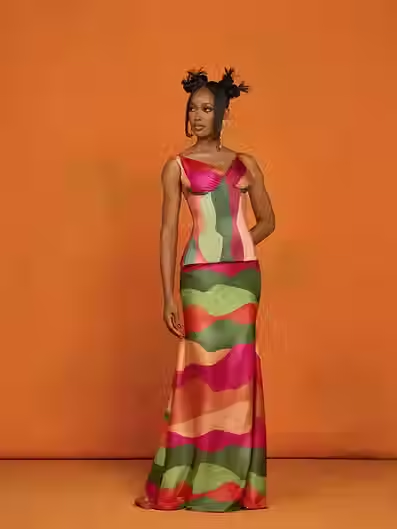
Rendoll has unveiled its Solea print, a design-led release centred on precision placement and form-driven construction.
The print is developed to follow the natural lines of the body, with each piece cut to accentuate feminine silhouettes while maintaining balance between structure and ease. The approach reflects a focus on controlled pattern placement, where design and garment construction work in tandem to enhance movement and fit.
Now available globally, the Solea offering positions print as both a visual and structural element within contemporary womenswear.
Brand
Hertunba Introduces “Akaọrụ̄ — Handwork” Collection

Hertunba has introduced its latest collection, Akaọrụ̄ — Handwork, an artisanal-focused body of work centred on craftsmanship, material exploration, and structured design.
The collection brings together woven, hand-dyed, crocheted, and beaded techniques, reflecting a collaborative approach to making. Signature pieces include the Mowa Set, developed through handwoven construction, and the Akwette Jacket, which reinterprets traditional textile heritage within a contemporary silhouette.
Across the lineup, garments such as the Nola Top and Dress, Dona Top 2.0 with Nku Pants, and the Nana Dress emphasise sculptural detailing, tailored balance, and hand-finished elements including beading and fringe. The Mowa Asoke Dress and Dinma Akwette Zip Dress further highlight the use of handwoven Aso-oke and Akwette fabrics, reinforcing the collection’s material-led direction.
Other pieces, including the Yuri Dress, Naya Top, and Nimi Crochet Dress, introduce fluid draping, structured cotton, and lightweight handcrafted textures, while sets such as Zuri and Nini explore layering, versatility, and hand-dyed finishes.
The collection extends into more experimental forms with looks like the Osi Tentacles Dress and Ewa Necklace Top, where garments take on sculptural and hybrid qualities, merging fashion with object-based design.
Through Akaọrụ̄ — Handwork, Hertunba positions craft not only as an aesthetic, but as a system of production, foregrounding process, technique, and the value of artisanal labour within contemporary African fashion.


Comments